
Subtitle: How to build an "Empire of One" that works while you sleep using modern MoR and Automation.
1. Beyond the Code: The Business is the System
In the first 11 posts of this series, we obsessed over the how: how to build at the edge, how to secure with HMAC, and how to use AI-native IDEs like Cursor. But in 2026, being a great engineer is only 50% of the equation.
The other 50% is building an Economic System.
A Sovereign Creator doesn't trade hours for dollars. Instead, they build an automated loop where content creates trust, trust creates transactions, and transactions trigger automated fulfillment. Your code is important, but the system that surrounds your code is what pays your rent.Today, we break down the three pillars of the 2026 Solopreneur Stack.
2. Pillar 1: Global Payments without the Tax Nightmare
If you are selling a digital product or a SaaS, the biggest bottleneck isn't the API—it's Global Compliance. Handling VAT in the EU, Sales Tax in the US, and fraud detection globally can kill a solo business before it starts.
This is why I recommend a Merchant of Record (MoR) over a raw payment gateway.
- Traditional (Stripe): You are the seller. You are responsible for every tax filing in every country.
- Modern (Lemon Squeezy): They are the seller of record. They handle the taxes, the invoices, and the compliance. You just get a payout.
| Feature | Stripe (Raw Gateway) | Lemon Squeezy (MoR) |
|---|---|---|
| Setup Speed | Complex (KYC/KYB) | Fast (Developer Friendly) |
| Tax Handling | You do it | They do it |
| SaaS Licensing | Requires extra tools | Built-in |
| Global Reach | High | High |
Rough mental model for engineers:
-
Setup Speed
• Stripe (raw): You wire everything yourself, from checkout UI to webhooks and dunning. • Lemon Squeezy (MoR): You get a ready‑made storefront and subscription engine.
-
Tax Handling
- Stripe (raw): You become the tax department for every country you sell to.
- Lemon Squeezy (MoR): They collect, remit, and handle the paperwork.
-
SaaS Licensing
- Stripe (raw): Needs extra tools or custom code to issue and manage licenses.
- Lemon Squeezy (MoR): Built‑in licenses and customer portal.
-
Global Reach
- Both can sell globally, but MoR lets you think in terms of “one global product” instead of “50 different tax regions”.
Action: For the [SyncMars Starter Kit] or any digital asset, I’m using [Lemon Squeezy (Link Pending)] to ensure I stay lean and compliant from day one.That way, I can spend my limited founder energy on product and content, not on chasing VAT rules.
3. Pillar 2: The Logic Glue (The No-Code Architect)
Once a customer hits "Buy," the magic happens behind the scenes. In 2026, I don't write custom Node.js scripts for every business automation. I use Make.com.
Make (formerly Integromat) is the "visual brain" of my business. When a transaction happens in Lemon Squeezy, it triggers a Make.com scenario that:
- Adds the customer to my beehiiv newsletter.
- Generates a unique API key in my database.
- Sends a personalized welcome message via AI-generated email.
- Pushes a notification to my Raycast dashboard so I can see the "Sale" in real-time.
By using Make.com, I can build complex business logic in minutes that would otherwise take days of debugging.I still write custom code where it truly matters—core product, security‑sensitive flows—but for glue work between tools, a visual automator beats another half‑maintained Node.js script every time.
4. Pillar 3: Managing the Business from the Command Bar
Efficiency is the currency of the solopreneur. I don't want to open 20 browser tabs to check my sales, my logs, or my customer support tickets.
As mentioned in Post 11, my entire OS is managed via Raycast.
For my "Economic Stack," I use Raycast for:
- Instant Currency Conversion: Checking global prices for my digital products.
- Snippet Management: Quickly pasting common support replies or license terms.
- AI Search: Using the Raycast AI to summarize my daily sales reports from various APIs.
If you aren't using a high-performance command bar to run your business, you are leaving hours of productivity on the table.Raycast isn’t “mandatory hardware” for a solopreneur, but it feels like overclocking your brain: the same stack, just with far less friction and context‑switching.
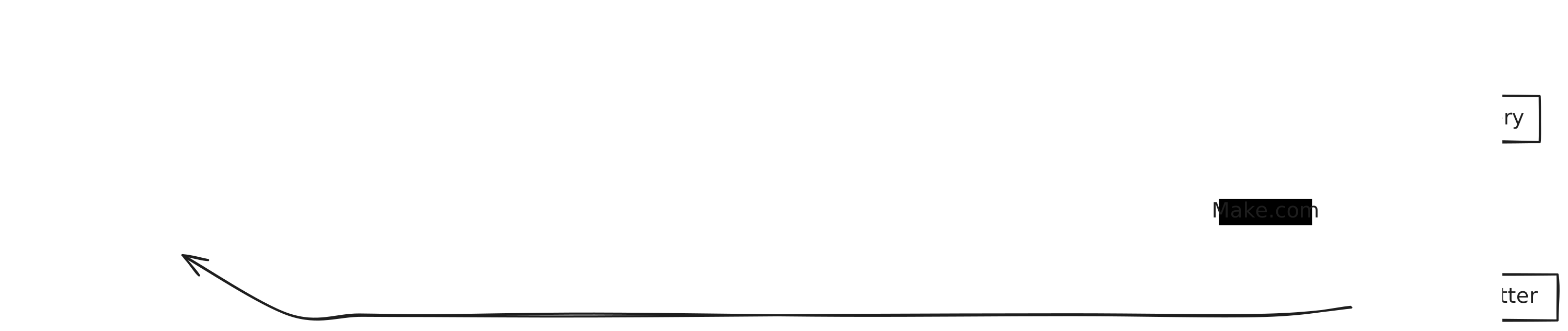
5. The "Flywheel" Diagram
This is how your 2026 economic engine should look. The goal is to minimize human intervention.If you are just starting out, this flywheel can begin very small: one good blog post, one simple product, one automation. You can layer sophistication later.
6. Conclusion: Build for Freedom
In 2026, the technology is "solved." The real challenge is orchestration. By combining a Merchant of Record like Lemon Squeezy, the visual logic of Make.com, and the lightning-fast interface of Raycast, you stop being a "coder for hire" and start being the CEO of an automated empire.
The system is your leverage. The system is your freedom.Tools will keep changing, but if you design the flywheel well, you can swap out components without touching the core of your Empire of One.