
Why 2026 is the year we stop "automating tasks" and start "delegating outcomes."
1. The Solo Builder’s Ceiling
If you’ve been following this series, you now have a high-performance, secure, and cost-effective Physical SaaS running 1,000 devices in the field. But here is the cold, hard truth: You are now the bottleneck.
Between fixing firmware bugs, answering customer support tickets, and trying to grow your presence on social media, you have no time left to actually build. In previous eras, this is where you would hire your first employee.
**In 2026, you don't hire a person; you orchestrate an Agent.**Your limiting resource is no longer compute or capital—it’s your attention.
2. From Automation to Agency
For years, we used tools like Zapier for "Trigger-Action" automation: If A happens, do B. For example: “When a form is submitted, add a row to Airtable.”.In the Agentic Era, we move to "Goal-Oriented" delegation: Here is the goal, here are the tools, now go achieve it.A modern agent brief sounds more like: “Keep my launch waitlist warm and ready to convert this month.”. By using frameworks like LangGraph or PydanticAI, we can create specialized "employees" that handle the heavy lifting of business operations.
3. Meet Your 2026 AI Team
I have organized my solo-operation around three core AI "departments." Each is a Multi-Agent system with its own set of tools.
A. The Growth Agent (Marketing & SEO)
This agent doesn't just "post to Twitter." It monitors semantic trends. It scans Reddit and Hacker News for people complaining about problems your hardware solves.
- Action: It identifies a high-value thread, synthesizes a helpful technical response based on your blog posts, and presents you with a "Draft to Approve" in Slack.
- Result: You get 10x the reach with only 5 minutes of "review time" per day.
B. The Support Engineer (Technical Success)
This agent is connected directly to your Device Shadows (see Part 7) and your documentation.
- Action: When a user emails saying, "My device isn't connecting," the Agent immediately pulls that specific device's heartbeat logs, identifies a firmware version mismatch, and writes a polite response: "I see your device is on v1.0.4. I've prepared an OTA update to v1.0.5 for you. Shall I push it now?"
- Result: Instant, high-tier technical support that never sleeps.
C. The Content Strategist (Education)
This agent takes your raw GitHub commits and technical notes and turns them into educational content.
- Action: It analyzes your recent code changes and generates a "Changelog" blog post, a LinkedIn summary, and a technical newsletter.
4. The Architecture: Human-in-the-Loop (HITL)
The biggest fear in 2026 isn't AI being "stupid"; it's AI being "too confident." You do not want an AI agent hallucinating a refund or insulting a customer on X.
The secret is the HITL (Human-in-the-Loop) Workflow. Every high-stakes action (sending an email, posting a tweet, charging a card) is placed in a "Review Queue."

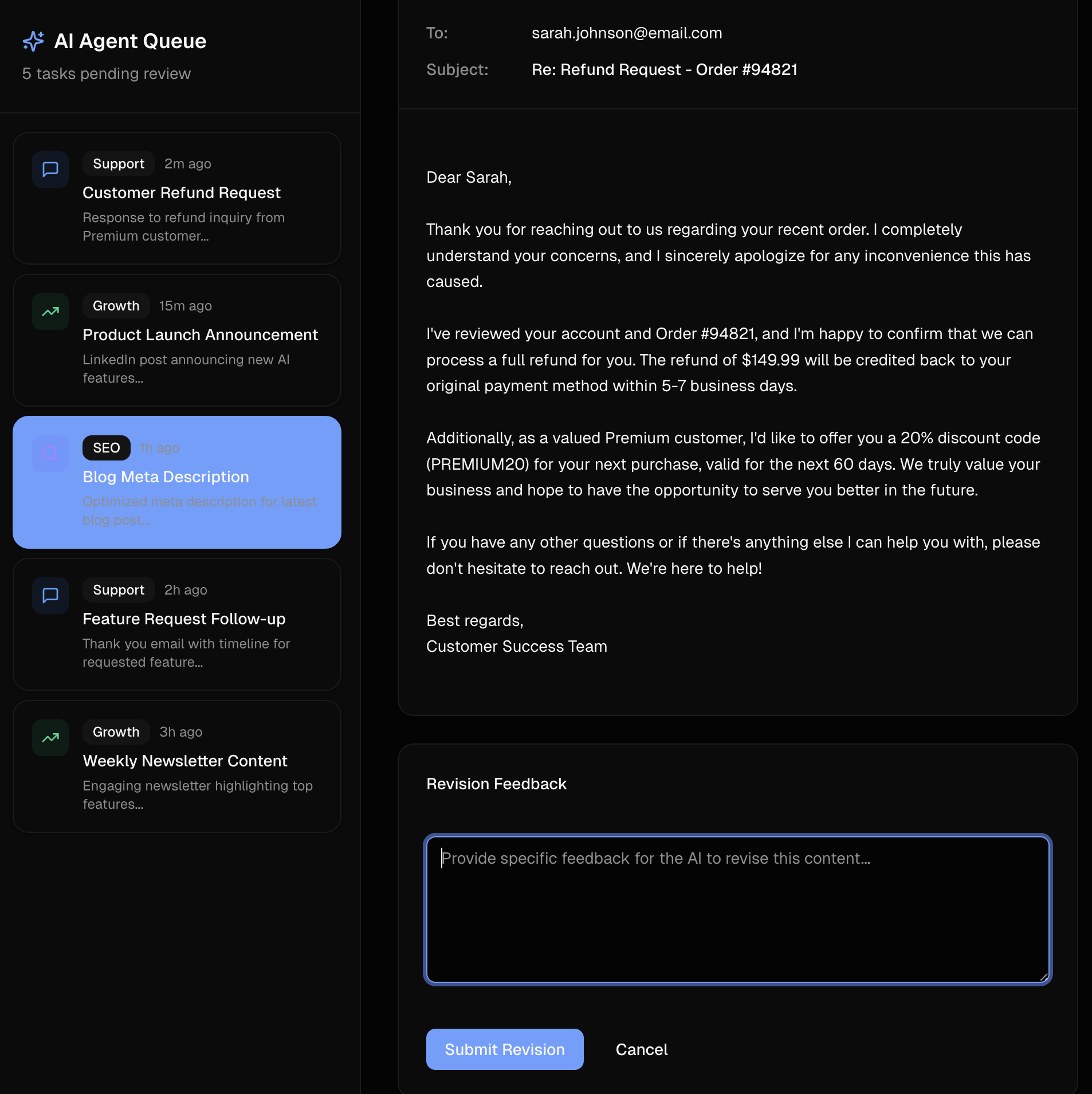
My daily routine: Reviewing 20+ agent-generated drafts in 5 minutes. No hiring, no management overhead, just strategic approval.
By acting as the Editor-in-Chief rather than the writer, you maintain 100% quality control while offloading 90% of the labor.In practice, you can require review for all outbound actions at first, then gradually auto-approve low-risk categories—like tagging a ticket or drafting an internal note—once an agent has proven reliable.
5. Staying Lean: The Cost of an AI Workforce
Because we optimized our costs in Part 6, running these agents is remarkably cheap. By using Small Language Models (SLMs) for routine monitoring and only "calling in the big guns" (GPT-4o or Claude 3.5) for final synthesis, your "AI Employee" costs less than a cup of coffee per day.Your goal is the same as with infrastructure: reserve expensive tokens for high-leverage decisions, and let smaller models and caches handle the rest.
6. Summary: The Company of One
In 2026, the most successful founders are not those with the largest payrolls, but those with the most efficient Agentic Orchestration. You are no longer a coder; you are a Commander of Agents.
By delegating the "ops" to AI, you free yourself to do what only you can do: Innovate.
Next Step: With our AI employees handling the day-to-day, it's time to sharpen our product's edge. In Part 9, we tackle the Latency War—how to achieve sub-100ms response times for AI and real-time streams to make your SaaS feel like magic.