In 2026, shipping a polished demo is easy; turning that demo into something people pay for is where most engineers stall.
AI-first tooling has demolished the barrier to starting projects. You can spin up a Next.js app, wire an LLM backend, and ship a shiny UI over a single weekend. What remains scarce is the boring, unsexy infrastructure that turns a cool demo into a durable product: uptime, billing, analytics, and a roadmap that outlives your initial motivation.
Your "Agentic Stack"—AI-native IDEs like Windsurf, containerized CI/CD, and scripted environments—already solved the "how do I ship more?" problem. The next level is asking a different question: "Which one of these projects deserves to become a product, and what does that transition actually look like over the next 30 days?"
This post is a practical blueprint for going from "weekend hack" to a sustainable SaaS product—without burning out, rewriting your entire stack, or dealing with tax compliance nightmares.
1. Demo Is Cheap, Product Is Rare
A SaaS product is not just "a project with Stripe attached"—it is a system that can survive users, bugs, and your future self. These are the four upgrades that separate a weekend hack from something you can sustainably run.
1.1 Architecture: The "Modular Monolith"
Most hacks start as a single repo with a single deploy target. That works—until you try to add multi-tenancy.
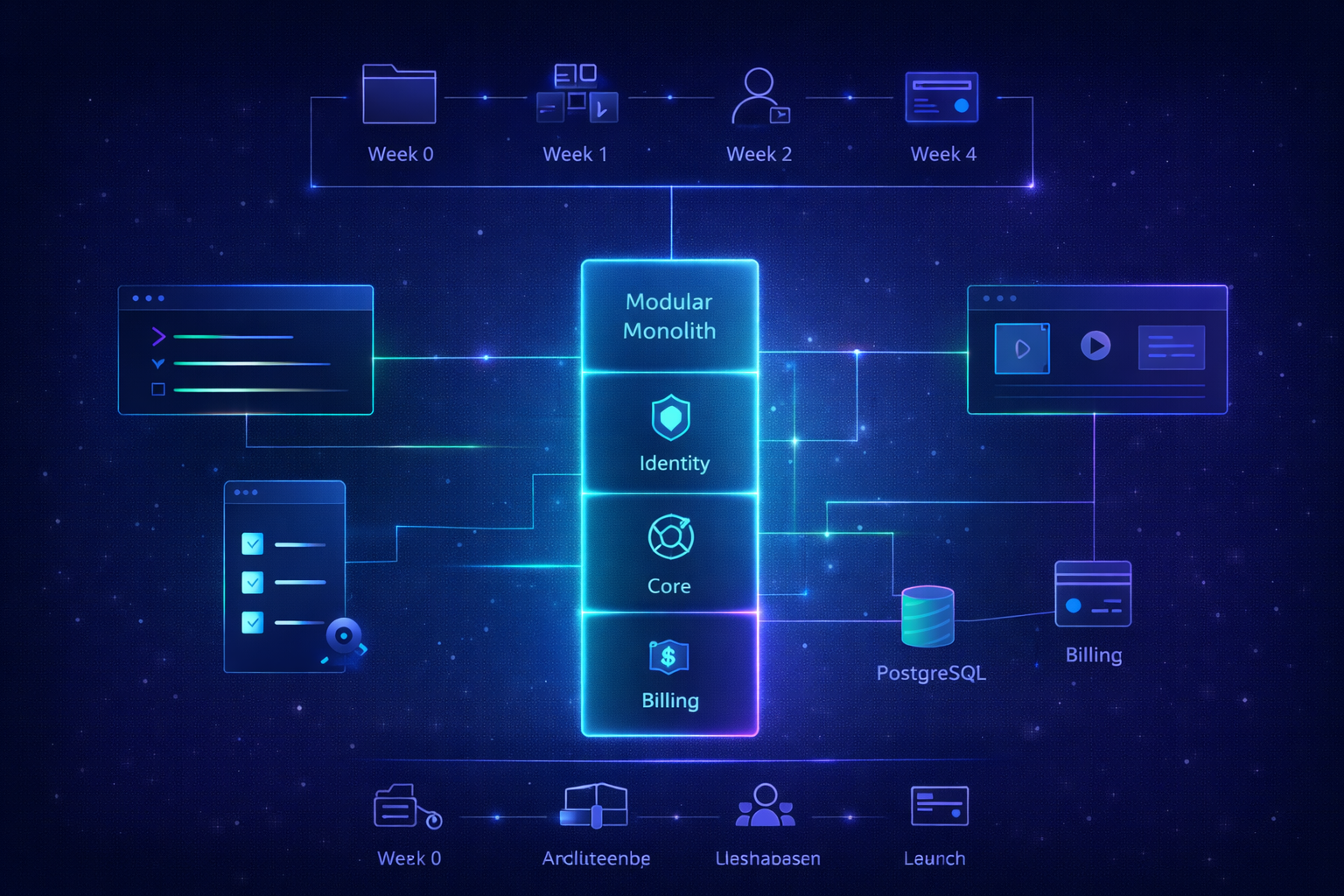
For a 30‑day SaaS-ification, you do not need a microservice migration. In 2026, the gold standard for solo founders and small teams is the Modular Monolith (Modulith).
- Structure: Keep code in one repo, but enforce strict boundaries between modules (e.g.,
Identity,Billing,Core_Domain). - Config: A single source of truth for feature flags and pricing plans.
- Mental Model: Design it so you could split the
Core_Domaininto a separate service later, but don't actually do it until you hit scale.
1.2 Infrastructure: Strategic Hybrid Strategy
As discussed in my previous post (Vercel vs. Netlify), the choice isn't binary. The winning play for early-stage SaaS is a Hybrid Strategy:
- Vercel: For the core app (Next.js App Router), dynamic API routes, and Edge functions where latency is critical.
- Netlify: For the marketing site, documentation, changelog, and status pages.
- Shared Backend: A primary Postgres database (Supabase/Neon) that serves both.
1.3 Operations: From "Blind" to "Observable"
Projects fail when you have no idea what’s happening in production. You don't need a complex Datadog setup yet, but you do need a minimum operational spine:
- Metrics: Request latency and error rates.
- Logs: Structured logs that trace a request from the Edge to the Database.
- Alerts: Simple thresholds for "Error Rate > 1%" or "Failed Payments."
1.4 Product Thinking: From "Cool" to "Payworthy"
Projects answer "Is this technically possible?" Products answer "Is this worth paying for, repeatedly?"
If you can’t draw a simple line from Usage → Value Delivered → Recurring Payment, you probably don’t have a product yet. Let that project stay in your lab.
2. The 30‑Day Blueprint
Let’s turn this into something you can literally put in your calendar. This is a 4‑week blueprint designed to work with an AI-first workflow: you make the decisions, the tools help with the execution.
Ground rule: For 30 days, you’re not allowed to start a new project. You can only refactor, harden, and commercialize one existing candidate.
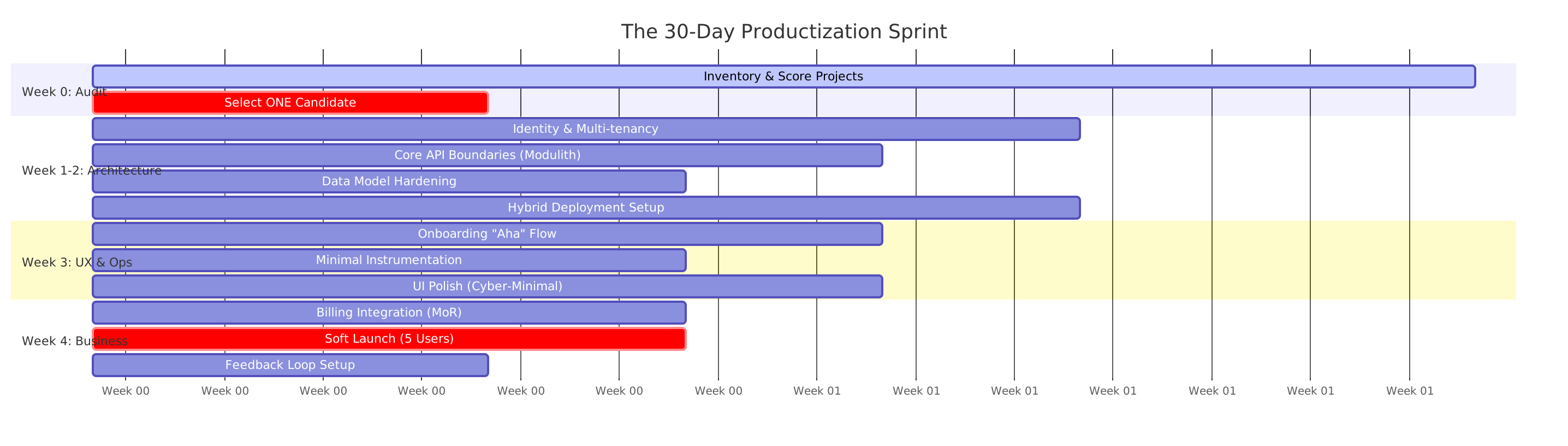
Week 0: Audit Your Project Graveyard
Before Day 1, take inventory. Score your last 3–7 projects on technical readiness and market clarity. Pick one. Everything else goes into a "later" folder. Focus is your scarcity.
Week 1–2: Minimal Architectural Upgrade
You’re not scaling to millions of users yet. You’re making sure the app doesn’t collapse under the first ten.
- Identity & Tenancy: Add a
tenant_idto your database tables. Decide if data is strictly siloed (Single Tenant) or shared (Multi-Tenant). - API Boundaries: Refactor your code to separate the "Billing" logic from the "Core Feature" logic.
- Data Sanity: Add
created_at,updated_at, and soft-deletes. Use your AI IDE to write the migration scripts.
Week 3: From "Engineer-Complete" to "User-Complete"
- Onboarding: Replace "Sign up and figure it out" with a guided 3-step flow. Get them to the "Aha!" moment in under 5 minutes.
- UI Polish: Adopt the "Cyber-Minimalist" aesthetic we discussed in the Physical SaaS post—high signal, low chrome.
- Instrumentation: Track the "Time to First Value." If users drop off before the magic happens, nothing else matters.
Week 4: Charging Money (The Smart Way)
In 2026, do not build your own billing backend.
- Use a Merchant of Record (MoR): Instead of raw Stripe, use Lemon Squeezy or Paddle.
- Why? They handle global sales tax, VAT compliance, and invoicing. As an engineer who values "No Overtime," you do not want to spend your weekends calculating EU tax rates.
- Launch: Release to 5–20 users. Your goal isn't revenue maximization; it's validating that someone will pull out a credit card.
3. A Concrete Example: SaaS-ifying the "Physical" Dashboard
Let’s apply this to the Real-Time Hardware Dashboard we built in the previous post.
The Current State: A cool tech demo where an FPGA sends data to Vercel Edge, verified by HMAC, and visualized on a Next.js dashboard.
The Product Upgrade (30 Days):
- Week 1 (Architecture): Introduce "Organizations." An Agency needs to log in and see their 50 devices, not everyone's devices. Isolate the data.
- Week 2 (Infra): Move the marketing landing page to Netlify to save Vercel bandwidth. Keep the dashboard on Vercel for that low-latency Edge access.
- Week 3 (Ops): Add rate-limiting. If a client's device goes rogue and spams 1,000 requests/second, the system should throttle that specific tenant, not crash the whole platform.
- Week 4 (Biz): Set up a "Per Device" pricing model on Lemon Squeezy.
You aren't rewriting the real-time pipeline; you are wrapping it in a business logic layer.
4. A No‑Burnout Action List
To keep this aligned with the "No Overtime" era, treat productization as a series of small, compounding moves—not a hero sprint.
- Ban New Projects: Commit to zero new repos for 30 days.
- Draw the Modulith: Diagram your chosen project. Identify the "Identity," "Core," and "Billing" boundaries.
- Deploy Hybrid: Split your
app.domain.com(Vercel) andwww.domain.com(Netlify). - Talk to Humans: Ask 3 potential users: "What would make this worth paying for every month?"
Your Agentic Stack gave you throughput. This SaaS Blueprint gives you leverage. In 2026, the real flex is not shipping 20 more repos—it’s turning one of them into a product that quietly pays for the rest.